

Marcus
Ask me anything, I am here to help you.
Enquiry Form
Enquiry Form
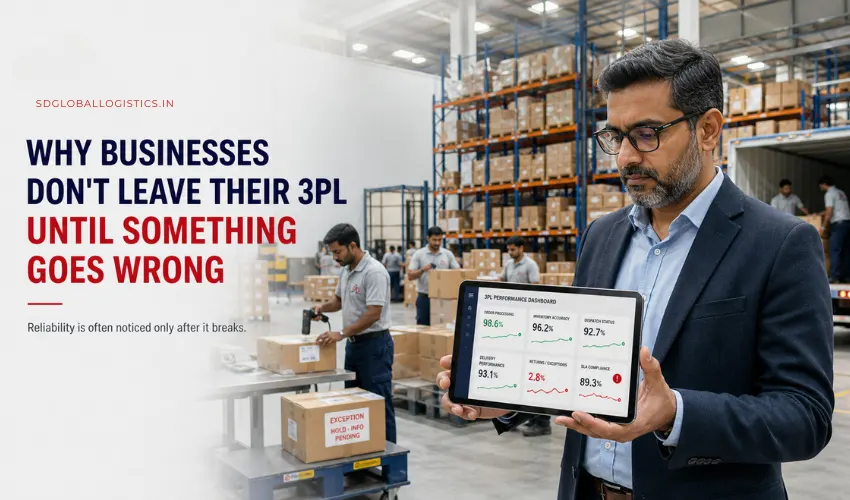
The reason many businesses remain with the same 3PL is that it is actually challenging to change warehouses, systems, processes, inventory, and transportation partners. When problems begin to impact customers, costs or availability of inventory, they become too difficult to ignore. Then it's too late.
Replacing a 3PL is not a like-for-like replacement of a supplier. A 3PL is woven into nearly every part of daily operations:
It often feels less like changing vendors and more like rebuilding part of the supply chain while it is still running.
The transition chain looks like this: 3PL Change → Warehouse Transition → Inventory Migration → System Integration → New Processes → Operational Stabilization
Every step carries risk. A poorly managed transition can disrupt production schedules, delay customer shipments, increase freight costs, and create compliance issues that take months to unwind.
This is why many businesses quietly accept problems. The switch feels riskier than the problem itself.
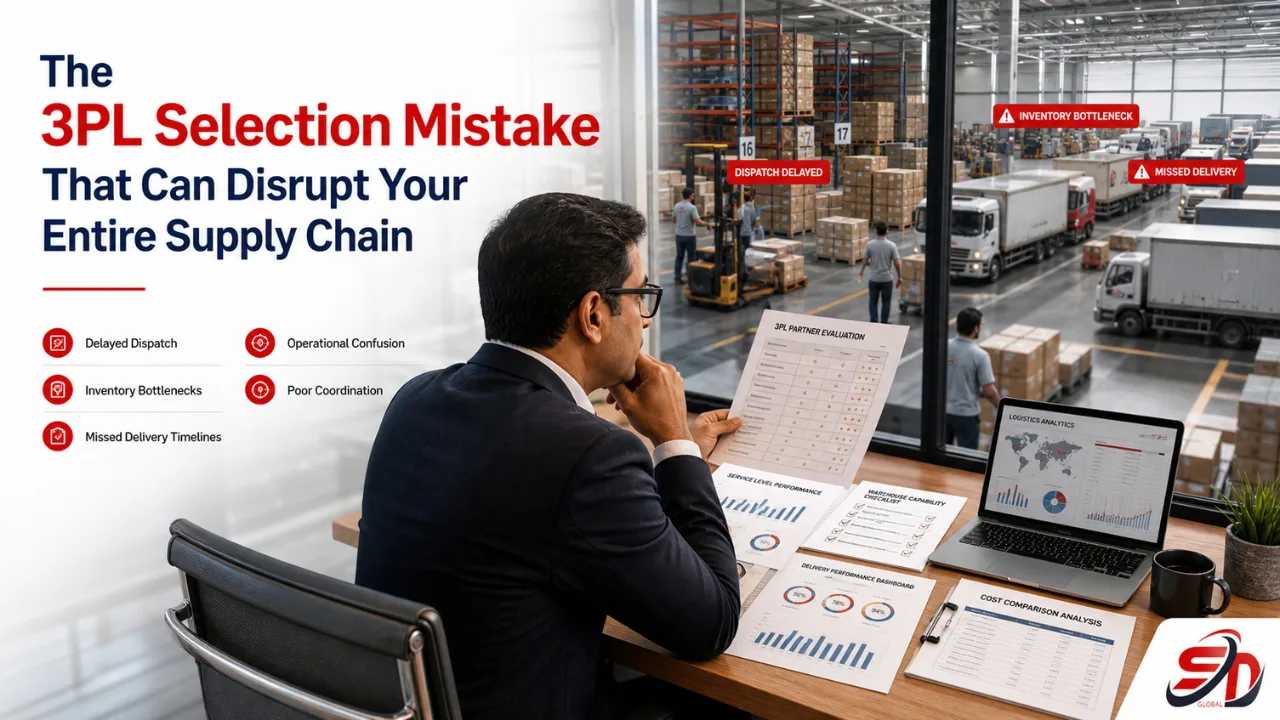
Most problems with 3PL don't just happen. They sneak in quietly — and that is why they are dangerous!
Common problems businesses absorb without escalating:
One isolated problem is manageable. A repeated pattern of underperformance is a different situation entirely.
This is where the risk becomes serious.
One inventory discrepancy = Exception Repeated discrepancies = Process Problem Regular stock discrepancies affecting orders = Supply Chain Risk
When a problem happens once, it gets logged and resolved. When it happens every week, it starts to feel routine. Teams stop escalating it. Management stops tracking it. And then, quietly, it starts affecting something bigger.Small operational issues can eventually impact:
A recurring warehouse problem is no longer "small" when it quietly absorbs your team's time and starts reaching your customers.
A low quoted rate is easy to see on an invoice. What it hides is harder to measure.
| What You See | What You Should Also Measure |
|---|---|
| Storage rate | Total warehouse cost per unit |
| Handling rate | Productivity and order accuracy |
| Freight rate | Reliability and transit performance |
| Low manpower cost | Output quality and service levels |
| Basic WMS | Visibility, integration capability |
| Contract price | Total cost-to-serve |
The lowest invoice does not always represent the lowest overall supply chain cost.
The transition cost should be weighed against the cost of staying with the wrong provider. Poor inventory accuracy, preventable damage, inefficient transportation, service failures, and compliance risk can be more expensive than the move itself.
Evaluate a 3PL partner on total performance—not just the line items on a monthly bill.
Are the system inventories the same as the physical inventories? Gaps indicate a warehouse management problem that will affect order fulfillment downstream.
Are customers getting what they have ordered? Errors here directly damage customer trust and increase return rates.
Are orders leaving the warehouse on the committed timelines? Consistent delays at dispatch affect every step that follows.
How quickly are exceptions identified, investigated, and closed? Slow resolution signals a weak operating culture.
Are logistics costs staying aligned with agreed commercial terms? Unexplained cost increases deserve structured review.
Can you clearly see live inventory positions, order status, and exceptions? A 3PL without strong WMS visibility limits your ability to manage your own supply chain.
Does your 3PL service provider have the capacity to support increases in volume, new SKUs, seasonal surges, and new locations?
There is a clear line between an isolated warehouse issue and a systemic risk.
Warehouse Error → Inventory Issue → Order Delay → Missed Delivery → Customer Complaint
Once a warehouse error reaches a customer, it is no longer a logistics problem. It is a business problem.
According to NTT DATA's 2025 Third-Party Logistics Study, more than 30% of shippers do not fully agree that their 3PL partners can solve their specific needs and challenges. The report indicates that this gap reinforces the need for strategic 3PL relationships that extend beyond transactional service.
The warehouse problem is no longer just a warehouse problem. It has become a customer experience problem, a revenue problem, and a brand problem.
Do not assume switching is always the right answer. The more important question is:
Is this problem correctable, or is it structural?
The distinction matters. A correctable problem deserves a structured improvement plan. A structural mismatch deserves an honest evaluation of the 3PL relationship.
Do not wait for a disruption to trigger a review. Build it into your operating calendar.
Review These Every Quarter
The objective is to identify patterns before they become disruptions.
Process: Measure → Review → Identify → Correct → Reassess
A healthy 3PL relationship is not just about operational execution. It is about how the two businesses work together.
A strong 3PL partner should provide:
3PL is no longer just about moving goods—it has become a strategic partner helping businesses scale, adapt, and stay competitive in a fast-changing market. The operating relationship should reflect that reality.
The right time to evaluate a 3PL is when operations are stable—not after a major failure.
Proactive reviews allow businesses to move through a clear, controlled process:
Performance Gaps → Root Causes → Corrective Actions → Better Service
This approach allows businesses to either strengthen the current partnership or make a structured, planned transition when necessary—rather than an emergency one driven by crisis.
India's 3PL market was valued at USD 24.87 Billion in 2025 and is projected to reach USD 78.54 Billion by 2034, expanding at a CAGR of 13.22%. As more 3PL options emerge across India, businesses have more choices than ever. The question is not whether better options exist. The question is whether you are measuring the relationship you already have with the right level of rigour.
From growing businesses to established enterprises, companies rely on SD Global Logistics to manage critical warehousing and logistics operations.














" We struggled with inconsistent inventory handling until SD Global stepped in with dedicated warehousing and tight process control. Their attention to detail brought stability to our entire supply chain. "

" Reverse logistics was a major pain point for us. With SD Global’s reverse logistics management and WMS integration, we finally got the visibility and efficiency we needed. "

" As a growing startup, flexibility was key. SD Global’s on-demand warehousing and responsive support scaled with us without locking us into rigid contracts. "

" Order delays used to slow us down. Thanks to SD Global’s order fulfillment and B2B logistics, we’re now running faster and more reliably than ever. "

" Our nationwide expansion needed a reliable network. SD Global’s Pan-India 3PL and shared warehousing model gave us the reach and agility we were missing. "
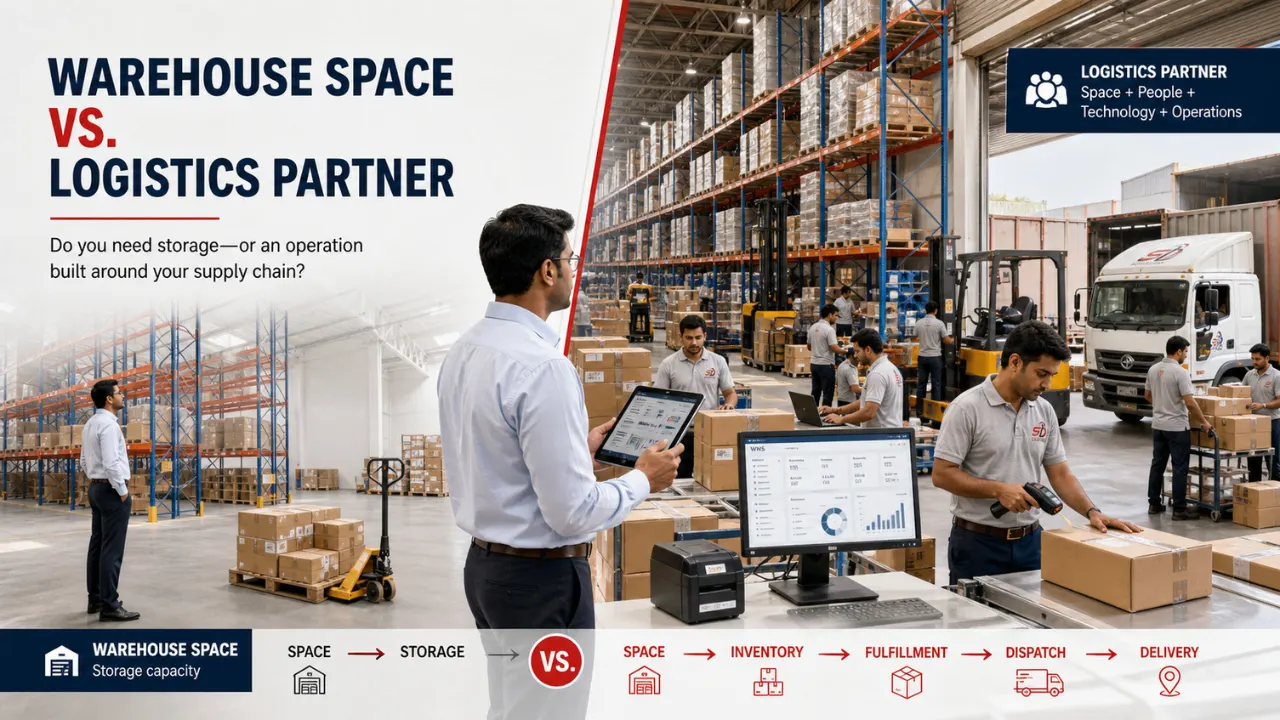

Hiring a warehouse gives your business a place to store inventory. With the hire of a logistics partner, you have the people, process, technology, fulfillment and expertise needed to effectively manage that inventory........
View Blog
The reason many businesses remain with the same 3PL is that it is actually challenging to change warehouses, systems, processes, inventory, and transportation partners.When problems begin to impact customers, costs....
View Blog
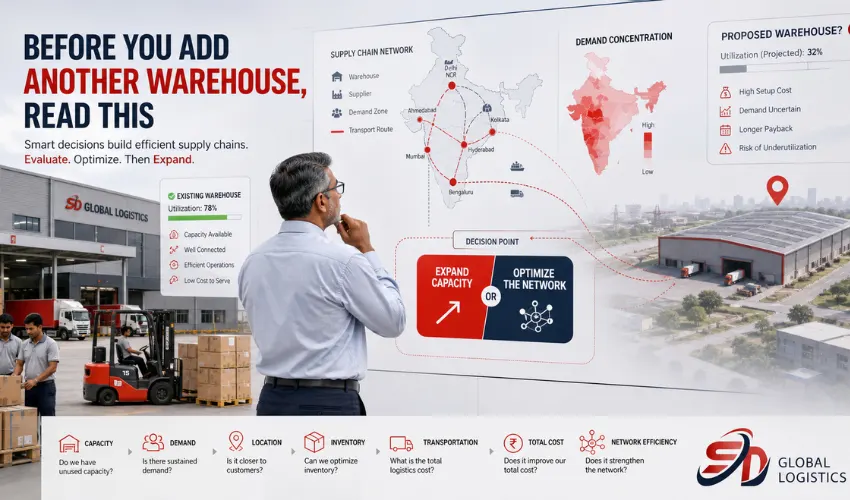
The answer is not always to build another warehouse. Before making a decision on an expansion, companies should look at true capacity utilization, inventory location, customer distribution, transportation costs, operational efficiency....
View Blog75+ warehouse locations positioned across major industrial, commercial and distribution markets.
Marcus
Ask me anything, I am here to help you.