

Marcus
Ask me anything, I am here to help you.
Enquiry Form
Enquiry Form
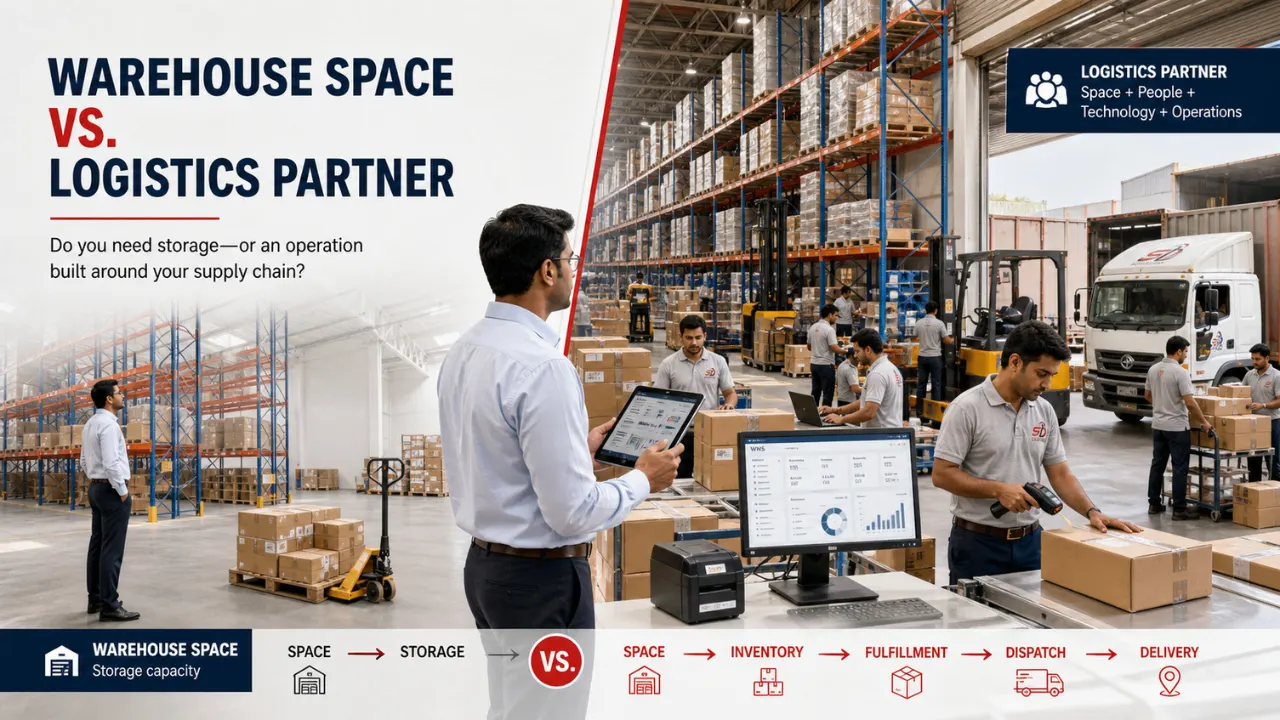
Hiring a warehouse gives your business a place to store inventory. With the hire of a logistics partner, you have the people, process, technology, fulfillment and expertise needed to effectively manage that inventory.
These are two very different decisions — and confusing one for the other can cost you significantly.
Here is a clear, practical breakdown to help you choose the right model.
One gives you four walls and a roof. The other can manage everything that happens inside — and beyond — those walls.
When a business leases a standalone warehouse, it typically receives:
Physical space — square footage to store your inventory
Basic infrastructure — loading docks, lighting, fire safety, security perimeter
Access rights — the ability to operate within the facility during agreed hours
The average rent per sq ft per month for warehouses in India for 2026 ranges between ₹18 to ₹60, depending on city, grade, and micro-location. In addition to rent, businesses should expect to pay a 3-6 month security deposit, CAM charges, and about a 5% annual rent increase with lock-ins of about 3 years being standard on Grade A leases.
This is the part many businesses underestimate.
Once you sign a warehouse lease, you are also taking on:
A logistics partner — also referred to as a 3PL partner or third-party logistics provider — can offer a far broader scope of services, depending on the agreement and the provider.
| Function | Warehouse Rental | Logistics Partner |
|---|---|---|
| Physical storage space | ✅ | ✅ |
| Receiving & put-away | ❌ | ✅ |
| Inventory management & WMS | ❌ | ✅ |
| Picking & packing | ❌ | ✅ |
| Order fulfilment | ❌ | ✅ |
| Dispatch management | ❌ | ✅ |
| Transportation & last-mile | ❌ | ✅ Varies |
| Reverse logistics | ❌ | ✅ Varies |
| Labour management | ❌ | ✅ |
| Reporting & data visibility | ❌ | ✅ |
| Value-added services | ❌ | ✅ Varies |
| Scalability across locations | ❌ | ✅ |
Note: Services depend on the provider and the scope of your contract. Always confirm what is included.
Supplier → [Receiving] → [Put-Away] → [Inventory Management]
→ [Picking & Packing] → [Dispatch] → [Transportation] → Customer
↓
[Reverse Logistics]
With warehouse rental, you manage every step after the supplier delivers goods.
With a logistics partner, the partner can manage each stage within the agreed scope — giving you visibility and operational control without building the infrastructure yourself.
Indian warehousing market is shifting from traditional storage to tech-enabled modern warehouses that offer value-added services, better inventory control and faster delivery speed. Indian companies are increasingly demanding new logistics capabilities and complex solutions from service providers to help with the successful management of supply chain processes and to bring down conventional logistics costs.
What this means in practice:
Inventory accuracy drops when there is no WMS. Mis-picks, stock discrepancies and overselling are common issues.
Fulfillment speed suffers when picking and packing processes are not optimised.
Customer experience deteriorates when there is no reliable dispatch tracking or returns process.
Scaling is difficult when each new market demands the establishment of a new facility, team and system.
A capable logistics partner addresses each of these problems within a single operational framework.
Key takeaway:Renting space solves the storage problem. A logistics partner can solve the operational problem.Renting standalone warehouse space makes sense when:
Consider a 3PL partner when:
Organisations across manufacturing and retail are leveraging 3PL partnerships to enhance operational efficiency, reduce capital expenditure on non-core assets, and access specialised logistical networks. Demand for 3PL warehousing in India is being seen in Tier 2 or Tier 3 cities as businesses are looking for greater geographical spread and faster delivery.
| Cost Element | Warehouse Rental | Logistics Partner (3PL) |
|---|---|---|
| Rent / Space | Direct cost | Included in service fee |
| Staff & Labour | Separate hire | Managed by partner |
| WMS / Technology | Separate investment | Often included |
| Transportation | Separate arrangement | Often integrated |
| Management Overhead | Your team | Partner's team |
| Scalability Cost | High (new lease, new team) | Lower (flexible capacity) |
| Setup Time | Months | Weeks (depending on scope) |
With warehouse rental, the visible cost is the rent. The real cost includes staffing, technology, transport, and management overhead on top.
With a logistics partner, you pay a service fee — but gain an operational team, processes, technology, and scale that would take significantly longer and cost more to build independently.
If you answered "no" or "unsure" to three or more of these, a logistics partner is likely the stronger option for your current stage.
Choosing between warehouse space and a logistics partner is not about what sounds better on paper. It is about what your business can realistically operate and afford.
If you have the team, the technology, and the processes — warehouse space gives you the control and cost structure you need.
If you need operational capability, speed, and scale — a logistics partner in India can deliver what a building alone never will.
The right question is not: "Where should we store our inventory?" It is: "Who should be responsible for running it?"
From growing businesses to established enterprises, companies rely on SD Global Logistics to manage critical warehousing and logistics operations.















" We struggled with inconsistent inventory handling until SD Global stepped in with dedicated warehousing and tight process control. Their attention to detail brought stability to our entire supply chain. "

" Reverse logistics was a major pain point for us. With SD Global’s reverse logistics management and WMS integration, we finally got the visibility and efficiency we needed. "

" As a growing startup, flexibility was key. SD Global’s on-demand warehousing and responsive support scaled with us without locking us into rigid contracts. "

" Order delays used to slow us down. Thanks to SD Global’s order fulfillment and B2B logistics, we’re now running faster and more reliably than ever. "

" Our nationwide expansion needed a reliable network. SD Global’s Pan-India 3PL and shared warehousing model gave us the reach and agility we were missing. "

Hiring a warehouse gives your business a place to store inventory. With the hire of a logistics partner, you have the people, process, technology, fulfillment and expertise needed to effectively manage that inventory........
View Blog
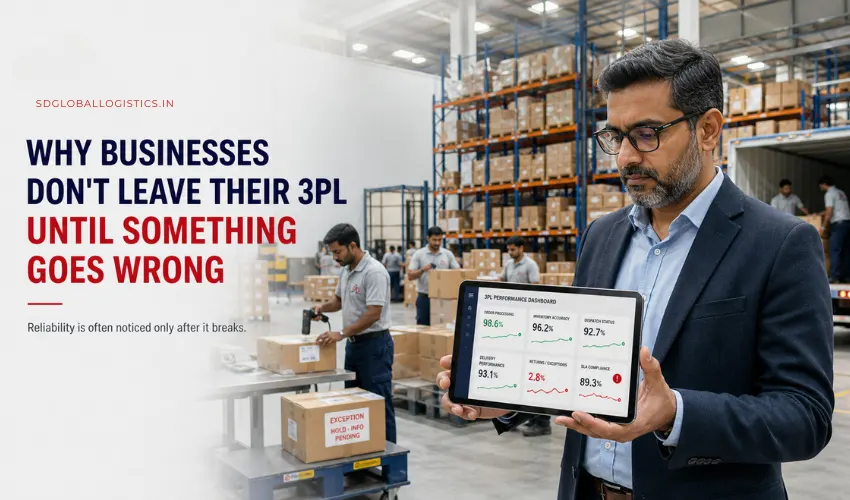
The reason many businesses remain with the same 3PL is that it is actually challenging to change warehouses, systems, processes, inventory, and transportation partners.When problems begin to impact customers, costs....
View Blog
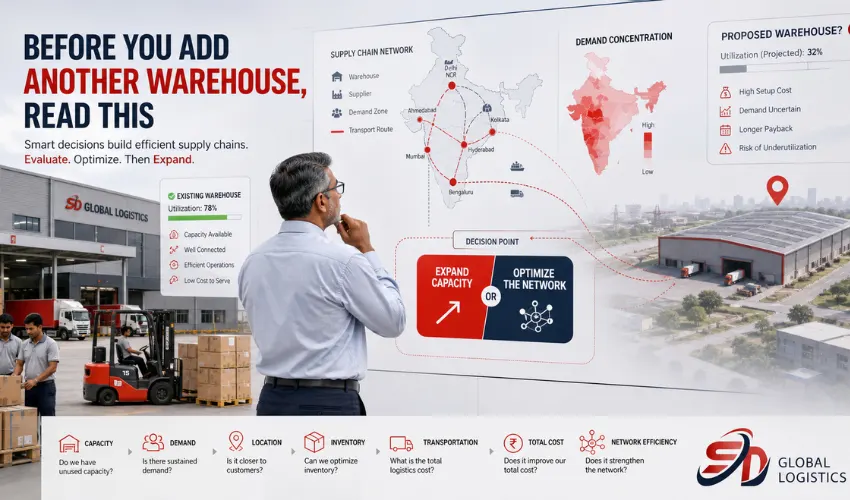
The answer is not always to build another warehouse. Before making a decision on an expansion, companies should look at true capacity utilization, inventory location, customer distribution, transportation costs, operational efficiency....
View Blog75+ warehouse locations positioned across major industrial, commercial and distribution markets.
Marcus
Ask me anything, I am here to help you.