

Marcus
Ask me anything, I am here to help you.
Enquiry Form
Enquiry Form
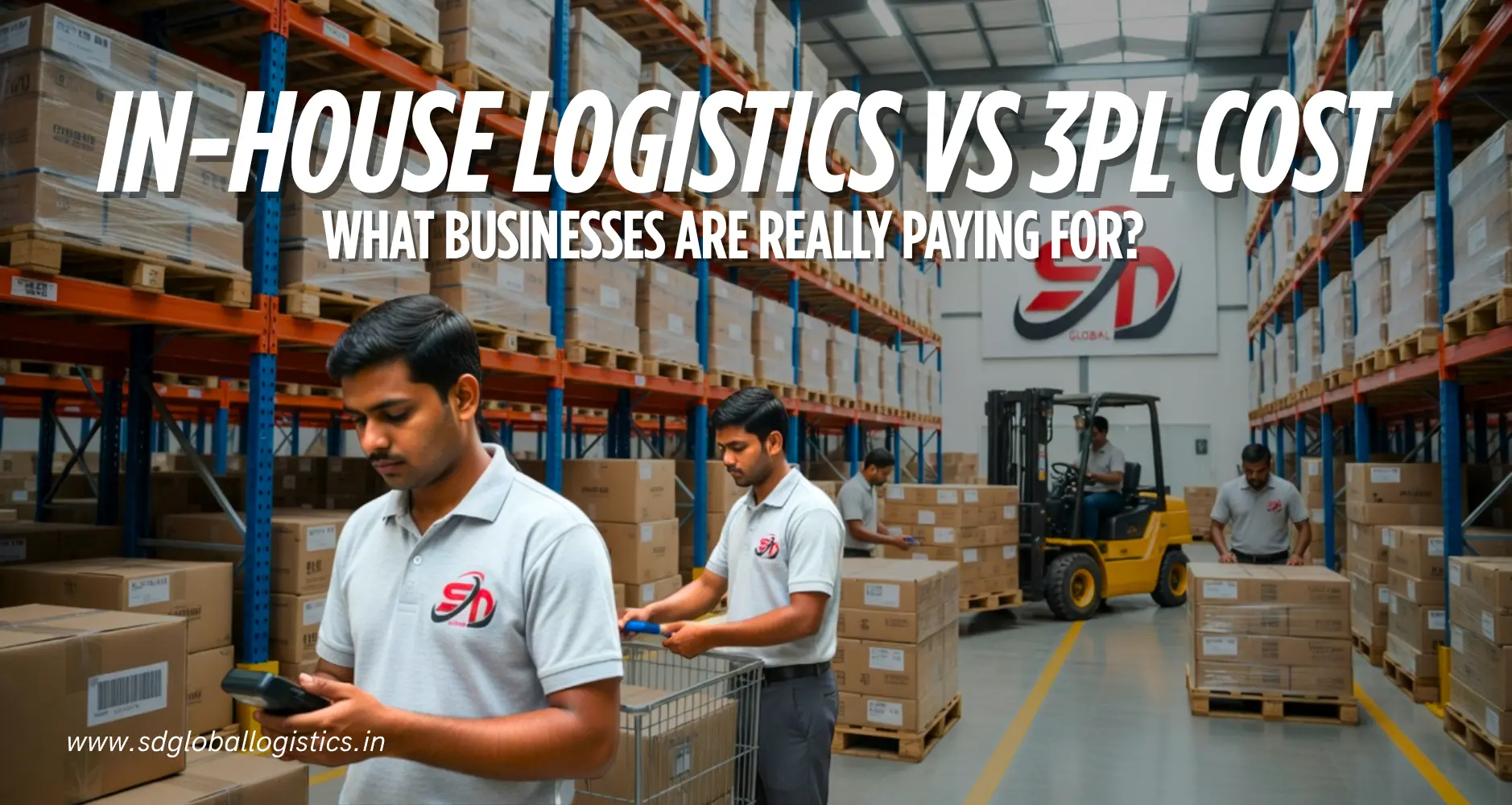
Looks like your business is expanding. Sales are going up and your staff is really busy. Every other week there seems to be a new problem to solve - for example, a shipment that got delayed or discrepancies in the stock. Eventually, all really successful brands reach such a point when they raise the question:
Should we manage logistics ourselves, or hand it over to a 3PL?
Initially, it might seem like just an internal operations decision. However, whether to have logistics in-house or outsource to a 3PL is in fact a major finance question — one that can greatly affect cash flow, ability to grow, and overall profitability in the long term.
Let's break it down practically, without the fluff.
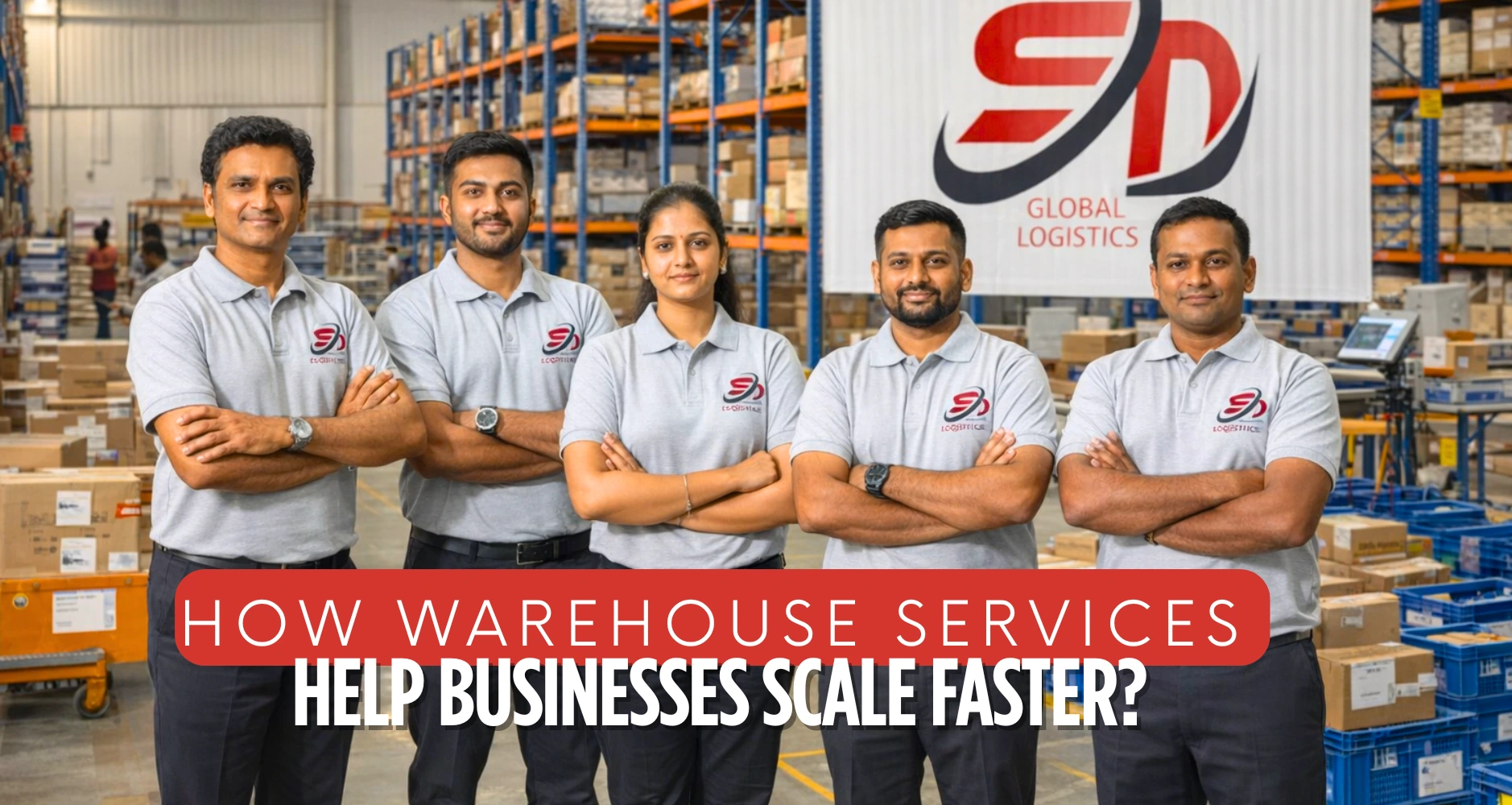
When you say you have logistics in-house it means that you are doing everything on your own — keeping the inventory, packing up the products, arranging the delivery as well as handling the returns. You can tailor the process to your liking and get the most out of your control. But it also gets more difficult the more orders you get.
On paper, it looks like the cheaper option. You own the process, you control the costs. But the reality is a bit more complicated.
A major disadvantage of in-house warehousing is that it is very expensive to establish a warehouse; costs are involved in buying or renting warehouse space, buying equipment and technology, and employing and training employees. These constitute only minimum costs.
Here's where those costs typically pile up:
And then there are the costs no one puts on a spreadsheet.
Unseen expenses may come as a shock. Under in-house logistics, you pay labor, benefits, overtime and training. You also have warehouse overhead, utilities and maintenance. There are additional costs due to technology upgrades and compliance. The fixed costs of rent, property taxes, insurance, and security are high: leasing or owning a warehouse. However, these are only the basics. You will also have to invest in equipment, and your space needs might be seasonal or as your product line expands. The bad news is that leases are not scalable - in other words, you might be paying to use space you are not using or you may have to scramble to get more space at the time when it really counts.
A 3PL is a "third-party logistics" company - companies that provide logistics and supply chain services like warehousing, pick and pack, order fulfillment, transportation and postage to other companies. Imagine it as your off-sourced logistics service. They possess the equipment, warehouse, and experience to manage your fulfillment operation; to include receiving stock, inventory management, picking, packing, shipping and even returns, as you concentrate on expanding your business.
Third-party logistics providers are companies that provide services and solutions for your business's supply chain. At any point in the supply chain, they are able to provide solutions: warehousing, transportation, distribution and most of the time even other areas like sales support, inventory management, and ecommerce fulfillment.
One of the biggest draws of 3PL is scalability. 3PL warehousing offers greater scalability compared to in-house solutions. 3PL providers typically have the resources and expertise to quickly scale operations up or down to meet changing demand, which can be particularly valuable for businesses experiencing growth or seasonal fluctuations in demand.
It is at this point that it gets really interesting. It is not a competition of which one is cheaper in the short term, but rather how your expenditures will work out in the long term.
When you run logistics in-house, you're committed to fixed expenses — rent, salaries, equipment leases — whether you ship 500 orders this month or 5,000. In-house logistics gives you direct oversight of operations, while 3PLs convert fixed costs into variable expenses that scale with your order volume, eliminating the financial risk of underused capacity during slow periods.
By handling your logistics in-house, you can end up with several fixed costs - rent, salaries, equipment leases, etc. These expenses stay the same whether you dispatch 500 orders this month or 5,000. On the other hand, keeping logistics in-house provides you with the ability to oversee all operations firsthand, while 3PLs change your fixed costs to variable ones that adjust according to your sales volume, thereby getting rid of the financial risk of having unused capacity during slower times.
If your business has busy and slow seasons, this flexibility helps you save money. You do not need to worry about paying for empty warehouse space or unused staff.
This cost flexibility is one of the most undervalued advantages of logistics outsourcing vs in-house management.
It is time consuming and costly to scale an in-house operation. New warehouse space, new staff, new equipment, it all costs capital and time. A 3PL removes those fixed costs - all you do is pay the space and services being consumed. Quickly scale up and down capacity by 3PLs. Growing inventory is easy to add or remove during slow seasons. Expansion of the company in-house is slower and riskier, because you have to lease more space or purchase equipment.
Operating a warehouse in the modern world requires a technological investment - WMS software, inventory-tracking, integrations of order management. The industry knowledge and infrastructure (such as warehouse management software) that 3PLs introduce are beyond the reach of many small businesses on their own.
Today knowledgeable 3PLs have managed to bridge the visibility gap by the real-time tracking and reporting dashboards that they offer and also give their clients access to technology such as warehouse management systems and AI route optimization which are the types of technological tools that are normally out-of-the-budget of most mid-market companies, hence it is freeing their capital for other revenue-generating activities like sales and product development.
Brands scaling from 10,000 to 50,000 orders typically see a 20–30% operational cost reduction through tiered pricing and carrier volume discounts. 3PLs leverage multi-client volume to negotiate carrier discounts and absorb peak season demand without requiring you to invest in additional infrastructure or hire temporary staff
The savings compound quickly when you're no longer absorbing the full weight of operational complexity yourself.
The warehouse outsourcing cost conversation often focuses on the obvious line items. But it's the invisible costs that quietly drain margins.
Here are the ones businesses consistently overlook:
Inventory mismanagement: DIY warehouse management can result into overstocking or suboptimal inventory or picking errors. Space and order accuracy are more difficult to control as your product line grows. Errors cost you money- in terms of lost sales, returns, or missed SLAs.
Delayed deliveries: It can be difficult to scale operations quickly. If a business experiences a sudden increase in demand, it may not have the capacity or resources to handle the increase in volume, which can lead to delays and reduced customer satisfaction.
Underutilized space: You are paying to use the floor space that is either occupied or not. Seasonal lows imply that you will be paying a facility that you are not using.
Workforce inefficiency: 3PL teams are normally in a better position to react promptly to demand fluctuations. This prevents the inconvenience and loss of employee productivity that will come with layoffs, relocating to a smaller warehouse, or selling unused equipment.
The bottom line? Managing fulfillment in-house may seem cheaper upfront — but over time, the overhead, hidden costs, staffing risk, and operational delays add up.
Logistics cost optimization is the goal for most businesses. Here's when a 3PL clearly makes more sense:
To be fair, in-house isn't always the wrong answer. For businesses with consistently high order volumes, in-house warehousing can be more cost-effective than outsourcing to a third-party provider. By owning and managing their own warehouse, businesses can avoid the costs associated with 3PL services.
It also makes sense when:
You're weighing control against agility, fixed expenses against variable scalability, and your team's bandwidth against specialized expertise. For mature operations with deep logistics capabilities, keeping it in-house can work well.
At SD Global Logistics, we work with businesses that are trying to answer exactly this question — and we've seen firsthand how the right logistics partner changes the numbers.
At SD Global Logistics, we work with businesses that are trying to answer exactly this question - and we have personally witnessed the difference that the proper logistics partner can make.
We have designed our approach based on process-driven warehousing, not a one-size-fits all model, but a structure that will conform to your product type, volume patterns, and complexities involved in fulfillment. Whether you're managing seasonal spikes, expanding to new cities, or juggling multi-channel fulfillment across ecommerce and B2B, our operations are designed to scale with you.
What that means practically:
We're not just a warehouse — we're a logistics partner invested in making your supply chain leaner and more responsive.
There's no universal answer here. The decision often comes down to your current constraints and where you're headed. Neither model is universally better — it depends on your business reality right now.
Ask yourself:
If you answered yes to most of those, it's worth having an honest conversation about outsourcing.
From growing businesses to established enterprises, companies rely on SD Global Logistics to manage critical warehousing and logistics operations.












" We struggled with inconsistent inventory handling until SD Global stepped in with dedicated warehousing and tight process control. Their attention to detail brought stability to our entire supply chain. "

" Reverse logistics was a major pain point for us. With SD Global’s reverse logistics management and WMS integration, we finally got the visibility and efficiency we needed. "

" As a growing startup, flexibility was key. SD Global’s on-demand warehousing and responsive support scaled with us without locking us into rigid contracts. "

" Order delays used to slow us down. Thanks to SD Global’s order fulfillment and B2B logistics, we’re now running faster and more reliably than ever. "

" Our nationwide expansion needed a reliable network. SD Global’s Pan-India 3PL and shared warehousing model gave us the reach and agility we were missing. "
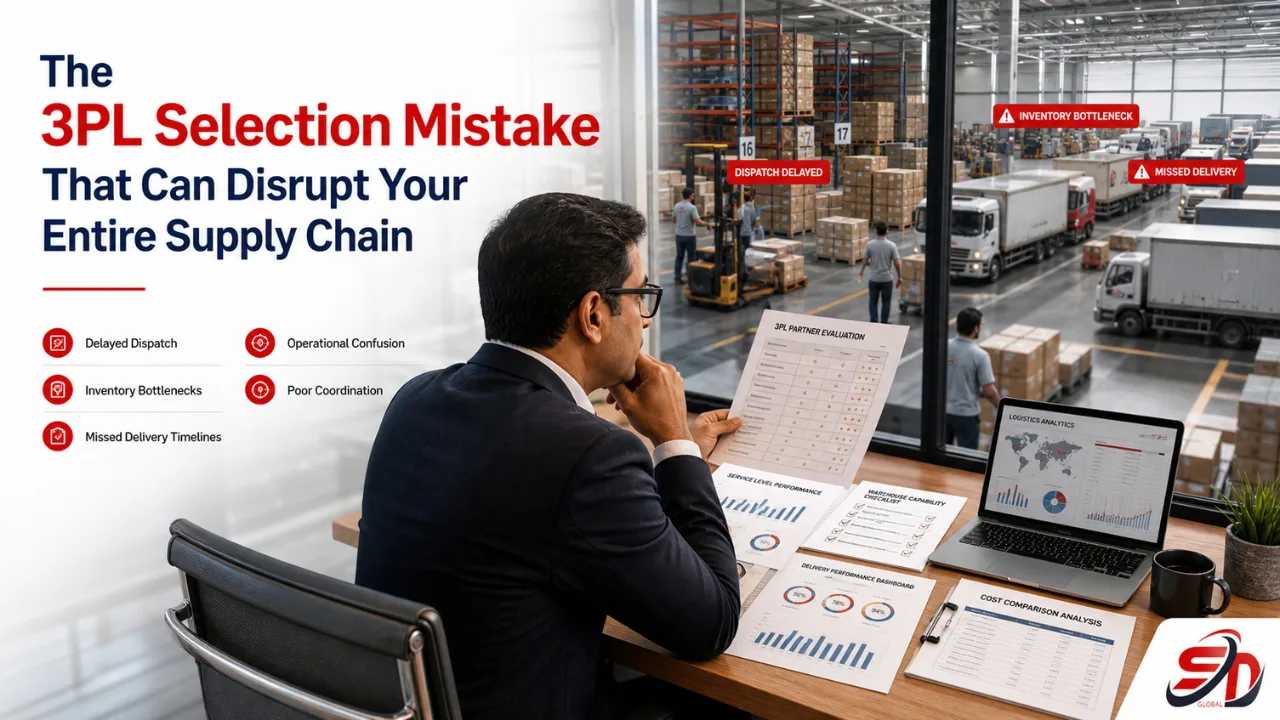

The most common error that companies make when choosing a 3PL is simply looking at the cost or warehouse capacity without assessing operational capability, technology, network, scalability, service levels and supply chain impact.
View Blog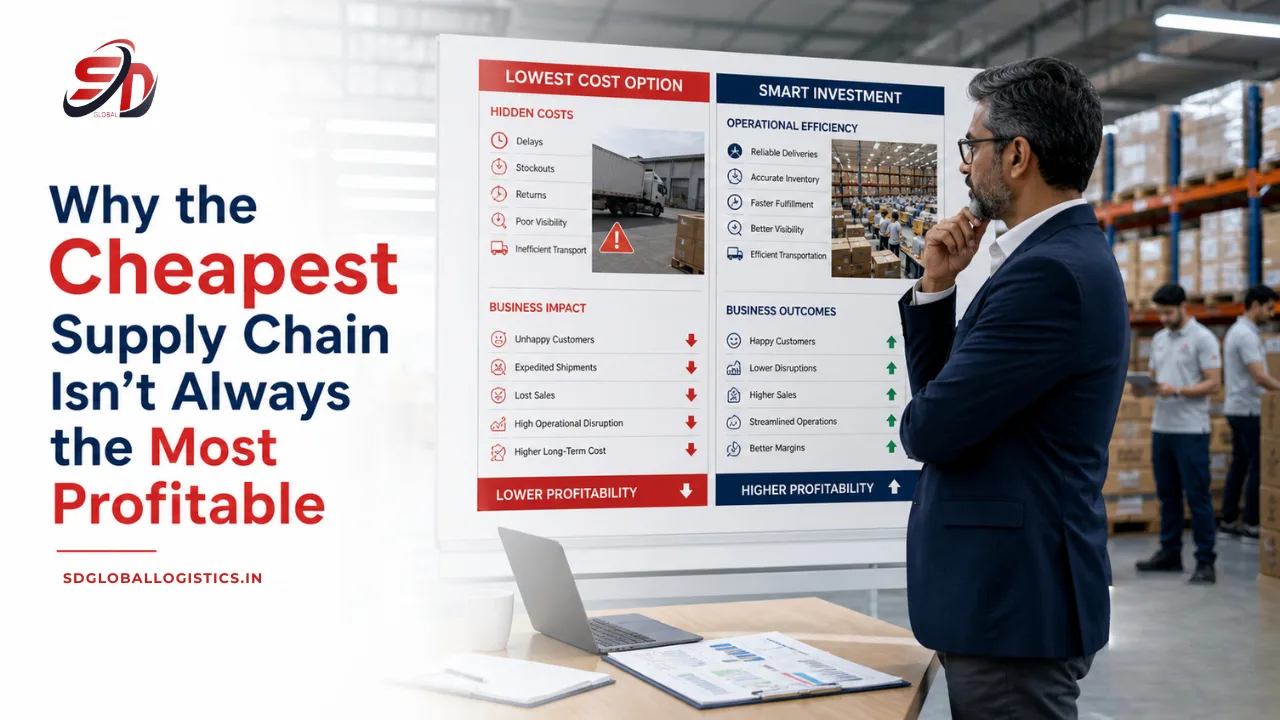
The cheapest supply chain is not always the most profitable — because cutting costs in one area almost always creates higher costs somewhere else. A low-cost warehouse in a remote location adds cos to transportation. The lower the wages, the more mistakes get made.
View Blog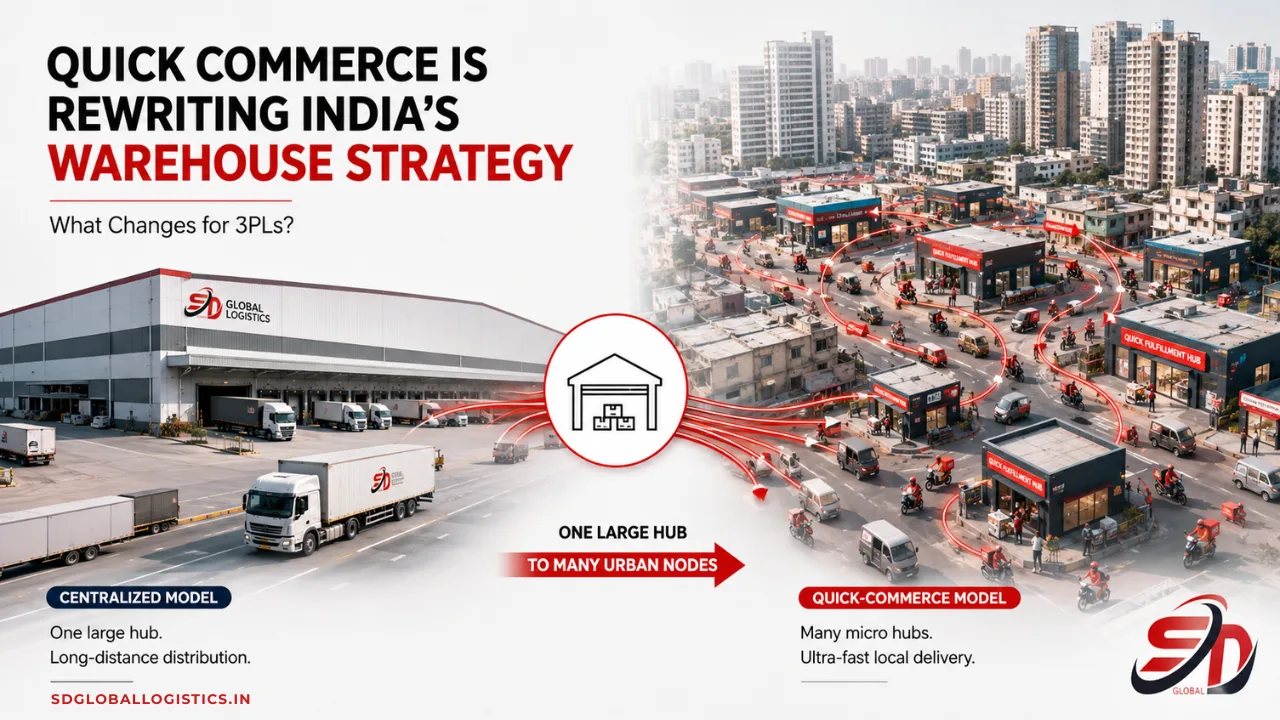
Quick commerce is pushing businesses away from centralised warehousing toward faster, more distributed fulfilment networks — and it is changing everything about how 3PLs manage inventory, locations....
View Blog75+ warehouse locations positioned across major industrial, commercial and distribution markets.
SD Global Logistics — your pan-India partner delivering scalable warehousing, technology-driven supply chain solutions and reliable, cost-efficient logistics for growing businesses
Developed By Rapiditors Technology India Pvt Ltd © 2025. All rights reserved.
Marcus
Ask me anything, I am here to help you.