

Marcus
Ask me anything, I am here to help you.
Enquiry Form
Enquiry Form
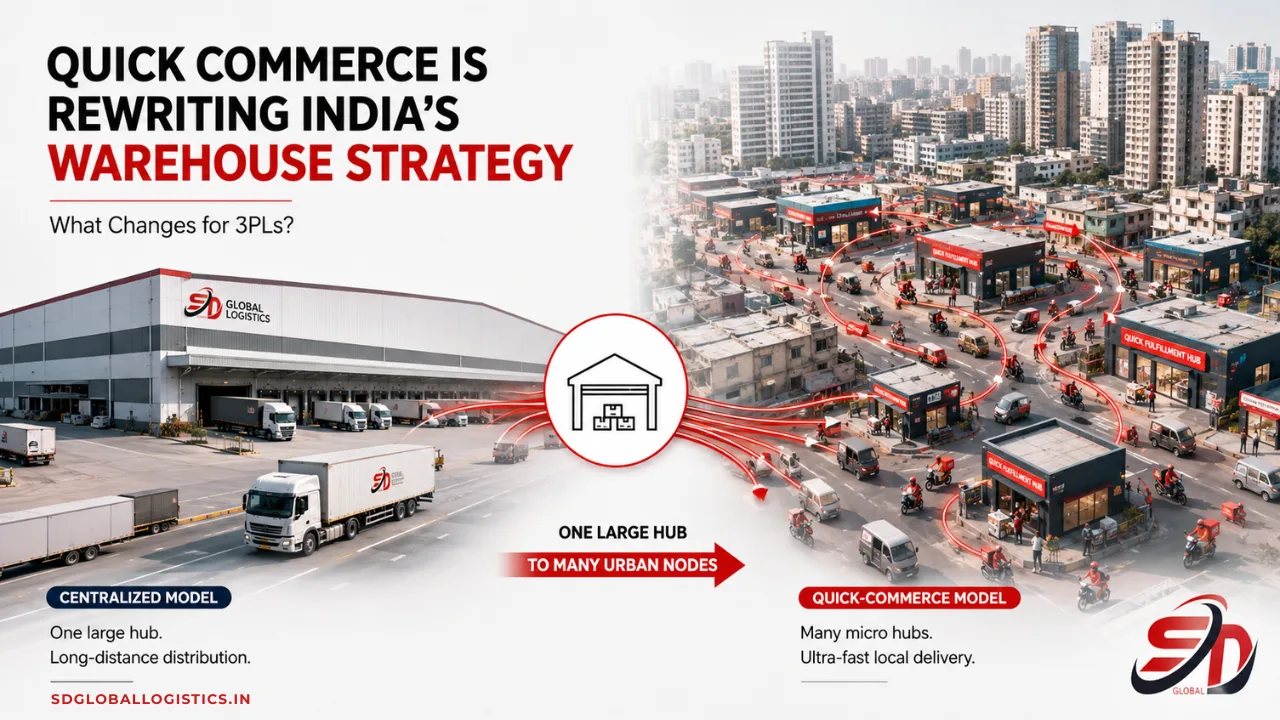
Quick commerce is pushing businesses away from centralised warehousing toward faster, more distributed fulfilment networks — and it is changing everything about how 3PLs manage inventory, locations, replenishment, and technology in India.
Quick commerce (q-commerce) is the delivery of everyday products, groceries, and essentials within 10 to 30 minutes of an order being placed.
It is not a niche trend.
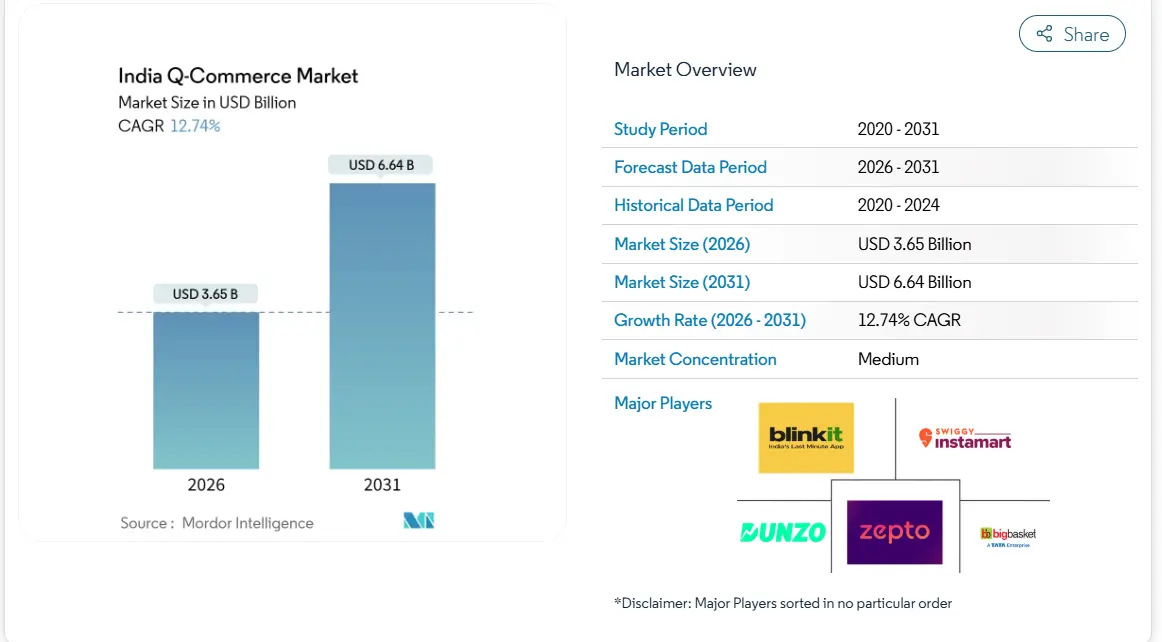
India's quick commerce market stands at USD 3.65 billion in 2026 and is forecast to reach USD 6.64 billion by 2031. Q-commerce orders made up about two-thirds of all online grocery orders in India in 2024, and roughly 10% of total e-retail spending. Quick commerce is currently concentrated in Tier-I metros like Bengaluru, Mumbai, Delhi-NCR, Chennai, and Hyderabad — but is expanding fast. Tier II cities are recording the fastest growth at 16.37% CAGR through 2031, driven by rising affluence and expanding dark store networks.
This is not simply faster delivery. It is a fundamentally different supply chain model.
Traditional ecommerce logistics followed a simple, linear path:
Inventory was held in one or two large facilities at the edge of a city or in a central location. Orders were picked, packed, and sent out — sometimes taking 24–48 hours to get to the customer.
Quick commerce breaks that model entirely.
Each step in this chain is shorter, faster, and more localised. And every step creates new demands on 3PL providers, warehouse operators, and logistics networks.
A dark store is a small, shopper-invisible micro-warehouse located close to urban demand. Dark stores are typically 2,500 to 5,000 sq. ft., positioned within a few kilometres of dense urban demand.
They are not open to the public. They exist purely to fulfil online orders at speed.
Speed does not come from a warehouse sitting 50 km outside the city — it comes from dark stores stocked with 2,000–3,000 high-demand SKUs, positioned within 2–3 km of where customers live.
This is where the real shift happens for 3PLs and warehouse operators.
Businesses can no longer rely on a single large warehouse to serve an entire metro area.
Dark stores carry limited stock, typically 2,000 to 3,000 SKUs. They run out fast.
Not all products belong in a dark store. Businesses must identify:
Quick commerce is currently strongest in Bengaluru, Mumbai, and Delhi-NCR — but it is expanding. Businesses need a warehouse network in India that can support multiple city-level nodes, not just one or two large facilities.
This is exactly where Pan-India warehousing solutions and multi-location 3PL warehouse services become business-critical.
As India's quick commerce market scales beyond what platforms can profitably manage in-house, third-party logistics providers are becoming the true infrastructure of dark store commerce.
Here is what that means in practice:
A single large warehouse works for standard ecommerce. It does not work for quick commerce fulfilment.
3PLs need:
Dark store replenishment is not a once-a-day task.
This requires:
Real-time inventory visibility is no longer optional.
3PLs need:
Quick commerce returns happen fast and require equally fast processing. Leading platforms are steadily expanding into higher-value categories such as premium personal care, lifestyle products, and time-sensitive medical supplies — all of which carry higher return rates and tighter quality requirements.
Running a distributed quick commerce warehouse network is more expensive than running a centralised model.
Here is the honest trade-off:| Factor | Centralised Model | Distributed/Q-Commerce Model |
|---|---|---|
| Warehousing cost | Lower | Higher |
| Delivery speed | Slower | 10–30 minutes |
| Inventory control | Simpler | More complex |
| Replenishment frequency | Weekly | Daily or more |
| Network flexibility | Lower | Higher |
The key is matching the model to your business requirements. Not every brand needs a 10-minute delivery promise. But for FMCG, groceries, personal care, and time-sensitive categories, proximity to demand is now a competitive advantage.
Key takeaway: Faster delivery costs more to operate — but losing market share to faster competitors costs more in the long run.If your brand is entering or scaling in quick commerce, use this checklist when evaluating a 3PL logistics partner:
3PL Evaluation Checklist for Quick Commerce:
Quick commerce is not simply making delivery faster. It is changing
where inventory must be stored, how often it must move, and what technology is required to manage it.
It is a completely different logistics architecture — Q-commerce is built around density, not distance.
For 3PL providers, the message is clear: adapt your network, invest in technology, and be ready to support clients who need faster, more distributed fulfilment than ever before.
For businesses: the right 3PL partner is no longer just a cost — it is the infrastructure that determines whether you can compete.
From growing businesses to established enterprises, companies rely on SD Global Logistics to manage critical warehousing and logistics operations.












" We struggled with inconsistent inventory handling until SD Global stepped in with dedicated warehousing and tight process control. Their attention to detail brought stability to our entire supply chain. "
" Reverse logistics was a major pain point for us. With SD Global’s reverse logistics management and WMS integration, we finally got the visibility and efficiency we needed. "

" As a growing startup, flexibility was key. SD Global’s on-demand warehousing and responsive support scaled with us without locking us into rigid contracts. "

" Order delays used to slow us down. Thanks to SD Global’s order fulfillment and B2B logistics, we’re now running faster and more reliably than ever. "

" Our nationwide expansion needed a reliable network. SD Global’s Pan-India 3PL and shared warehousing model gave us the reach and agility we were missing. "

Quick commerce is pushing businesses away from centralised warehousing toward faster, more distributed fulfilment networks — and it is changing everything about how 3PLs manage inventory, locations....
View Blog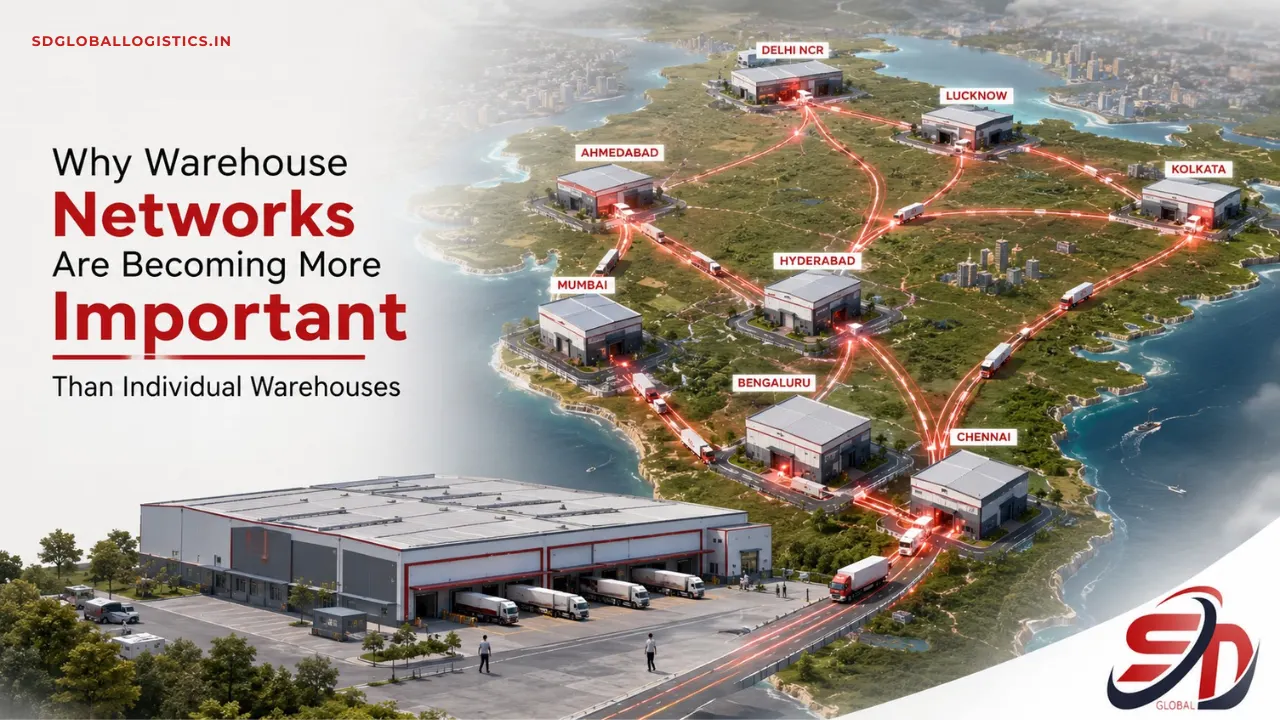
The Core Shift: A warehouse network provides businesses with the ability to locate stock closer to several customer and demand centres, optimising the delivery process, minimising long-distance....
View Blog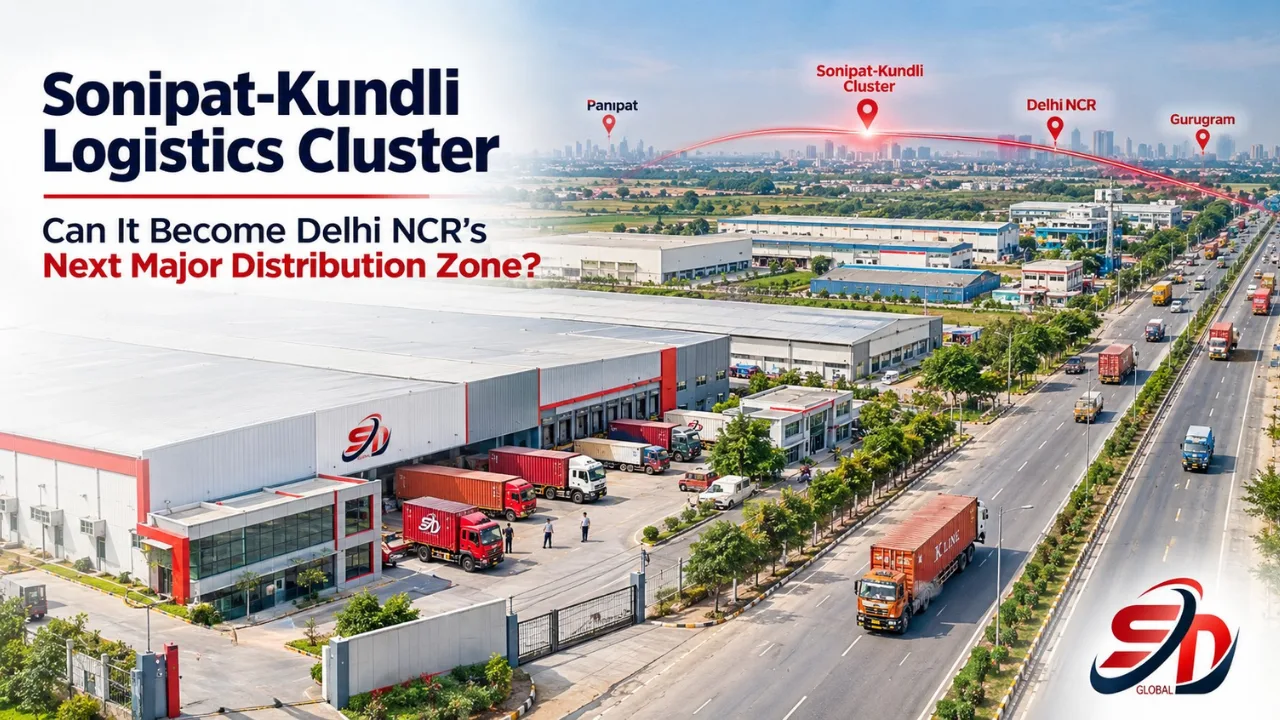
The Sonipat-Kundli logistics cluster is best evaluated as an emerging regional North India distribution hub — not yet a pan-India play. UER-II is operational.The KMP Expressway bypass is proven....
View Blog75+ warehouse locations positioned across major industrial, commercial and distribution markets.
SD Global Logistics — your pan-India partner delivering scalable warehousing, technology-driven supply chain solutions and reliable, cost-efficient logistics for growing businesses
Developed By Rapiditors Technology India Pvt Ltd © 2025. All rights reserved.
Marcus
Ask me anything, I am here to help you.