

Marcus
Ask me anything, I am here to help you.
Enquiry Form
Enquiry Form
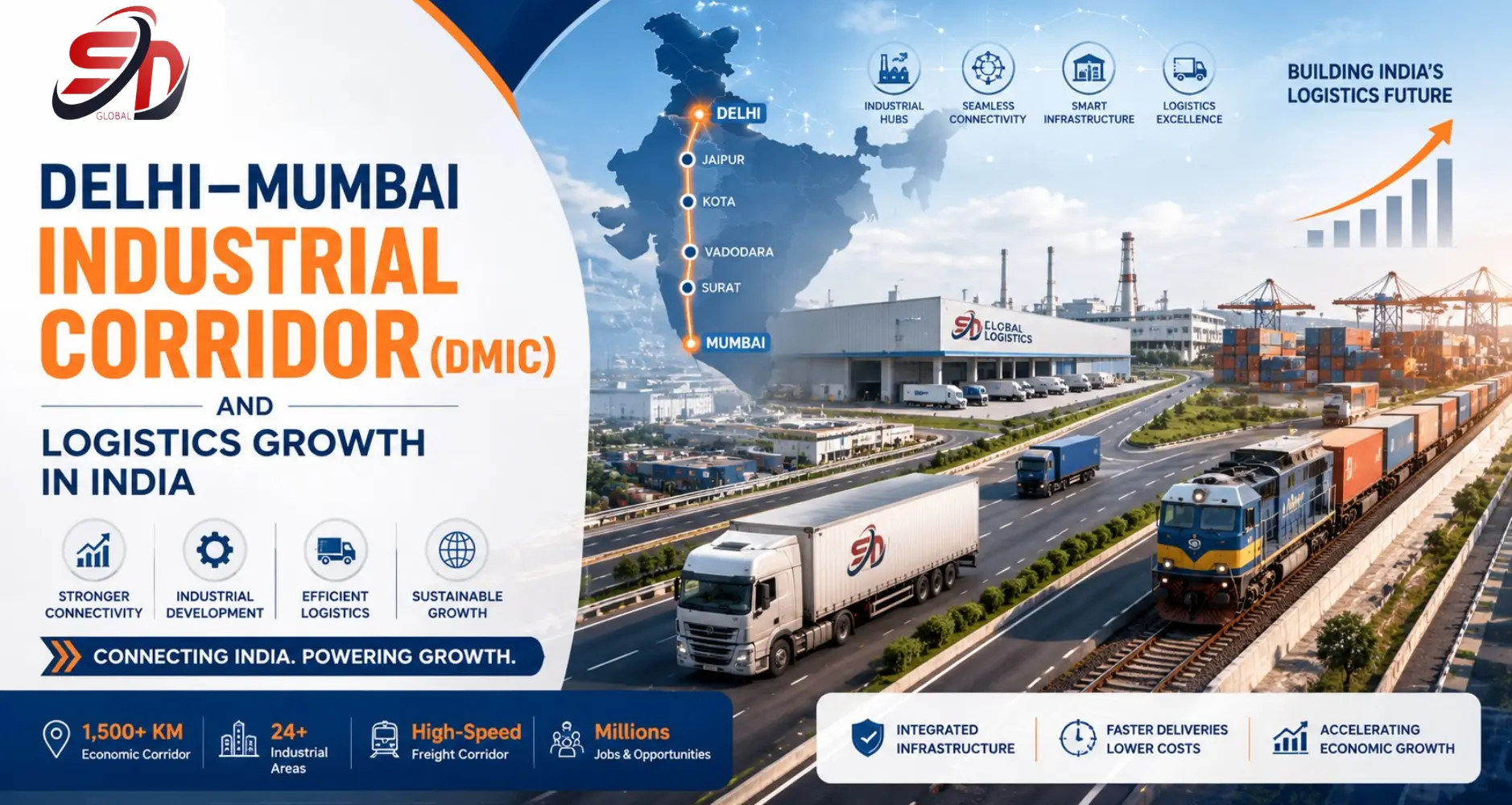
India is shaping its future and the Delhi–Mumbai Industrial Corridor (DMIC) is essentially the core of that drive. In fact, if you are following the logistics growth in India, this corridor shouldn't be just another infrastructure announcement lying unattended in the government files. It is a live, developing project that has been continuously changing the landscape of the manufacturers, warehouse operators, eCommerce fulfillment networks, and third-party logistics services among others in six states.
Let's break down what's actually happening, why it matters, and where the real opportunities lie.
The Delhi–Mumbai Industrial Corridor is among one of the most ambitious infrastructure projects in India that stretches 1,504 kilometers through six states. Announced in 2008 jointly with Japan, the project's goal is to increase employment by four times and industrial output by three times within five years after its full operation.
The corridor will develop smart cities, industrial zones, logistics hubs, and infrastructural facilities all along the 1,500 km route connecting Delhi and Mumbai. It is located along the Western Dedicated Freight Corridor (DFC) between Delhi and Mumbai and along the way, the corridor goes through Uttar Pradesh, Delhi NCR, Haryana, Rajasthan, Gujarat, and Maharashtra with the two main terminals being Dadri in Delhi NCR and Jawaharlal Nehru Port (JNPT) near Mumbai.
This is what the DMIC does: It's not simply a matter of connecting a warehouse in Delhi to a warehouse in Mumbai. Instead, it establishes a full-fledge ecosystem of production, storage, and transportation between the two most important cities in India - Delhi (political capital) and Mumbai (financial capital).
For decades, India's industrial logistics suffered from fragmented infrastructure—bad roads, congested railways, uncoordinated port access. The DMIC was conceived to fix this at scale.
The corridor consists of 9 mega industrial zones, ultra-fast freight lines, 3 new ports, 6 greenfield airports, and a 6-lane expressway connecting Delhi and Mumbai. While development activities have spread across the 11 industrial corridors, 4 of the locations are already fully operational and 4 more are nearing completion; thus, the government is constantly Improving domestic manufacturing capacity, attracting large private investments, and creating employment opportunities on a large scale.
Several key nodes are already active or nearing completion. Investment inflows are already occurring in areas like Dholera Smart City, Shendra-Bidkin Industrial Area, and Greater Noida with sectors like electronics, automobiles, and renewable energy. Manesar–Bawal in Haryana is becoming a manufacturing and logistics powerhouse, Neemrana and Ajmer in Rajasthan are providing excellent industrial land, Dholera SIR in Gujarat is a global smart city development model, and Shendra–Bidkin is reigniting the Pune-Aurangabad industrial belt in Maharashtra.
For businesses scouting locations for an industrial warehousing facility or a new manufacturing unit, these nodes represent ground-zero opportunities.
The timing of the DMIC couldn't be better. India's warehouse sector is booming independently, and the corridor is amplifying that momentum.
The Indian warehouse market size is estimated at USD 38.99 billion in 2025, and is expected to reach USD 59.34 billion by 2030, at a CAGR of 8.76%. India's warehousing and logistics sector has entered 2026 on a stronger footing, supported by improved occupier sentiment, resilient domestic demand, and continued infrastructure upgrades. The sector is anticipated to witness annual absorption exceeding 45 million sq ft by the end of 2026.
The Indian warehousing market is expected to be driven by several factors including the rising popularity of the e-commerce segment, fast industrialization, and government steps to upgrade the infrastructure.
Industrial warehouses are going to hold the largest market share in 2025 (56%), due to the growth of the manufacturing sectors supported by the Make in India initiative as well as the increasing needs of third-party logistics providers.
The DMIC amplifies this by clustering industrial and warehousing services along a connected corridor, reducing the distance between factory floors and distribution points. Whether you're running a warehouse in Delhi or operating out of Bhiwandi near Mumbai, the corridor's freight backbone changes the economics of storage and distribution.
The real game-changer here isn't just roads or rail lines—it's integration.
When it comes to logistics, the main pivot is really the freight backbone. The corridor is mapped out along the Western DFC alignment between Delhi and Mumbai, which is a game-changer in terms of how manufacturers decide the location of their factories—since they generally prefer areas from where both the supply of raw materials and dispatch of finished goods can happen faster and with greater certainty.
The corridor effect creates two big cost shifts especially for businesses: first is the lower time cost because of faster and more predictable deliveries and second is the lower inventory cost due to less buffer stock being needed when supply chains are very reliable.
That's exactly why the demand for logistics parks, distribution hubs, and industrial warehousing tends to be concentrated around operational nodes.
The Western DFC facilitates the movement of raw materials and finished products across the Indian territory more easily and quickly, which leads to cost reduction for businesses in logistics. Besides that, the government is also planning to reduce logistics and supply chain costs in India from 13–14% to 10% of GDP.
eCommerce companies will especially benefit from this and get their tangible results. A warehouse in Mumbai linked by DFC to the suppliers in Gujarat or Rajasthan can reduce the fulfillment windows drastically. Similarly, a company that is going to a warehouse in Delhi gets access to the northern manufacturing belt and is still connected to the western port infrastructure.
The DMIC is creating fertile ground for
third-party logistics services to scale. Leasing activity remained robust in Q1 2026, led by 3PL, engineering & manufacturing, and consumer goods occupiers.
The introduction of GST has played a very important role in conversion from fragmented storage to large centralized warehouses, leading to a nearly 20% logistics cost efficiency improvement. Layer the DMIC's multimodal connectivity on top of this, and you get a supply chain environment where third-party providers can offer faster transit, better inventory visibility, and more competitive pricing.
The warehousing industry of India is changing drastically, leaving tier II and III cities not only as the sources of growth but also as the centers of warehousing.
As per the 2024 data, India's overall warehousing stock was 533.1 million sq ft while emerging tier II–III cities accounted for about 100 million sq ft—a fourfold increase since 2017. Also, many of these tier II cities such as Jaipur, Ahmedabad, Surat, Vadodara are situated directly on the DMIC route, which is no coincidence.
If you're a manufacturer, logistics operator, or investor evaluating opportunities tied to the industrial corridor in India, here's where to focus:
The Delhi–Mumbai Industrial Corridor is not just a line on a map. It's not even an infrastructure project—it's the driving force behind India's industrial renaissance. With integrated smart cities, optimized infrastructure, and environmentally friendly growth practices, the DMIC is ready to make India a global economic powerhouse.
For anyone in manufacturing, eCommerce, or logistics, the question isn't whether the DMIC will reshape India's supply chain—it's whether you'll be positioned to benefit when it does. India is witnessing a rapid warehousing growth, the logistics infrastructure development in the country is at a very advanced stage now, and the industrial corridor is finally bringing the fruits of its long-standing promise. Corporations that act quickly - such as obtaining warehousing services in the areas with the best potential, teaming up with reliable third-party logistics services, or locating their activities near newly developing hubs – will be well prepared to take advantage of this wave of industrial logistics transformation.
The corridor is being built. The freight lines are running. The only thing left is for smart businesses to show up.
From growing businesses to established enterprises, companies rely on SD Global Logistics to manage critical warehousing and logistics operations.














" We struggled with inconsistent inventory handling until SD Global stepped in with dedicated warehousing and tight process control. Their attention to detail brought stability to our entire supply chain. "

" Reverse logistics was a major pain point for us. With SD Global’s reverse logistics management and WMS integration, we finally got the visibility and efficiency we needed. "

" As a growing startup, flexibility was key. SD Global’s on-demand warehousing and responsive support scaled with us without locking us into rigid contracts. "

" Order delays used to slow us down. Thanks to SD Global’s order fulfillment and B2B logistics, we’re now running faster and more reliably than ever. "

" Our nationwide expansion needed a reliable network. SD Global’s Pan-India 3PL and shared warehousing model gave us the reach and agility we were missing. "
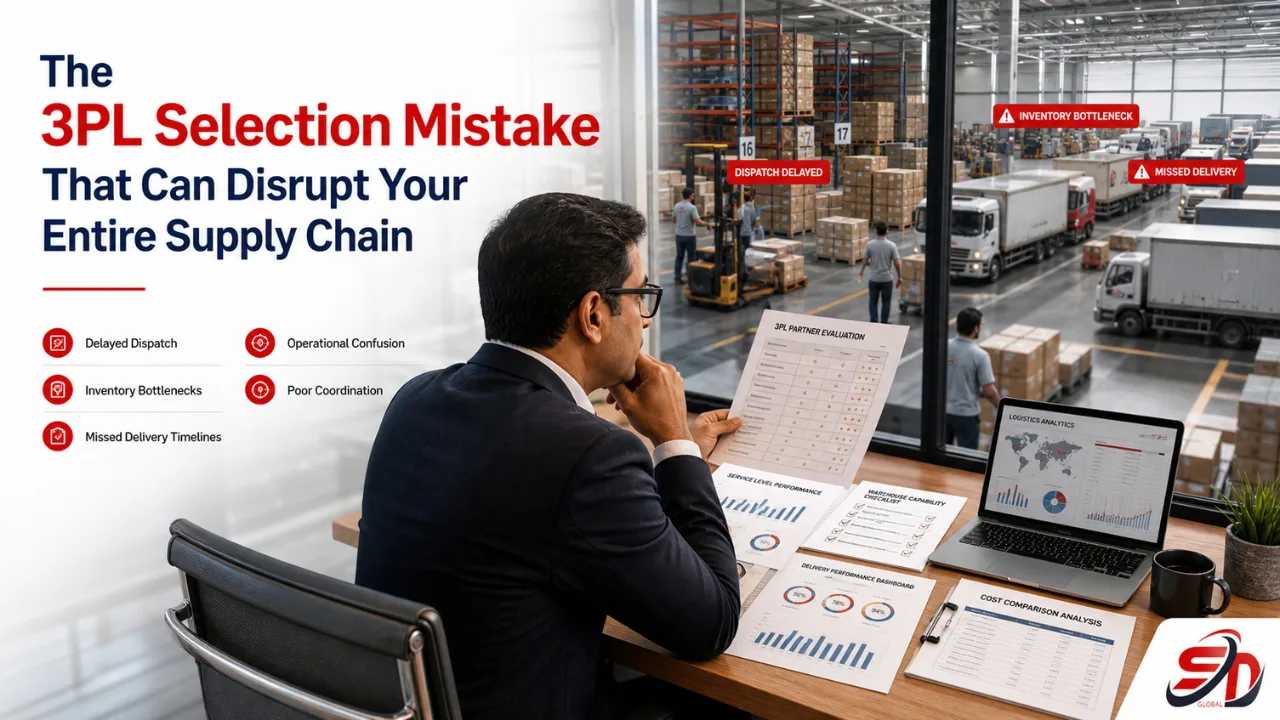

The most common error that companies make when choosing a 3PL is simply looking at the cost or warehouse capacity without assessing operational capability, technology, network, scalability, service levels and supply chain impact.
View Blog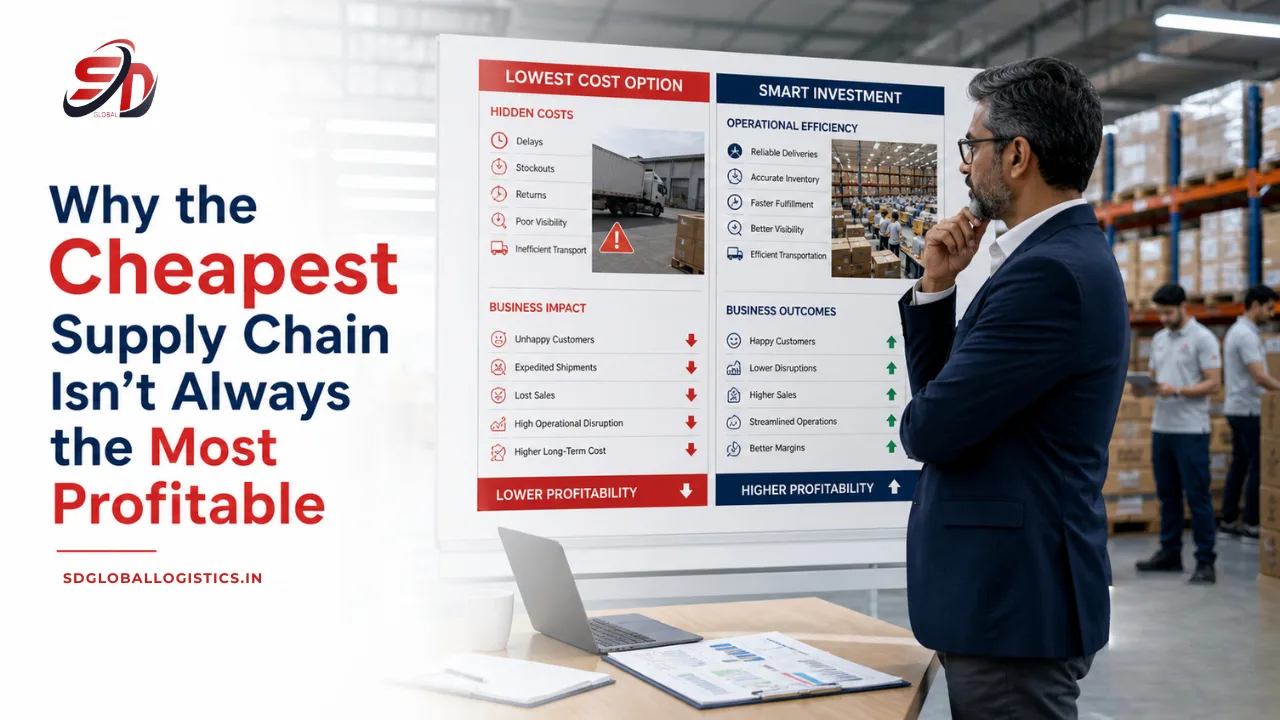
The cheapest supply chain is not always the most profitable — because cutting costs in one area almost always creates higher costs somewhere else. A low-cost warehouse in a remote location adds cos to transportation. The lower the wages, the more mistakes get made.
View Blog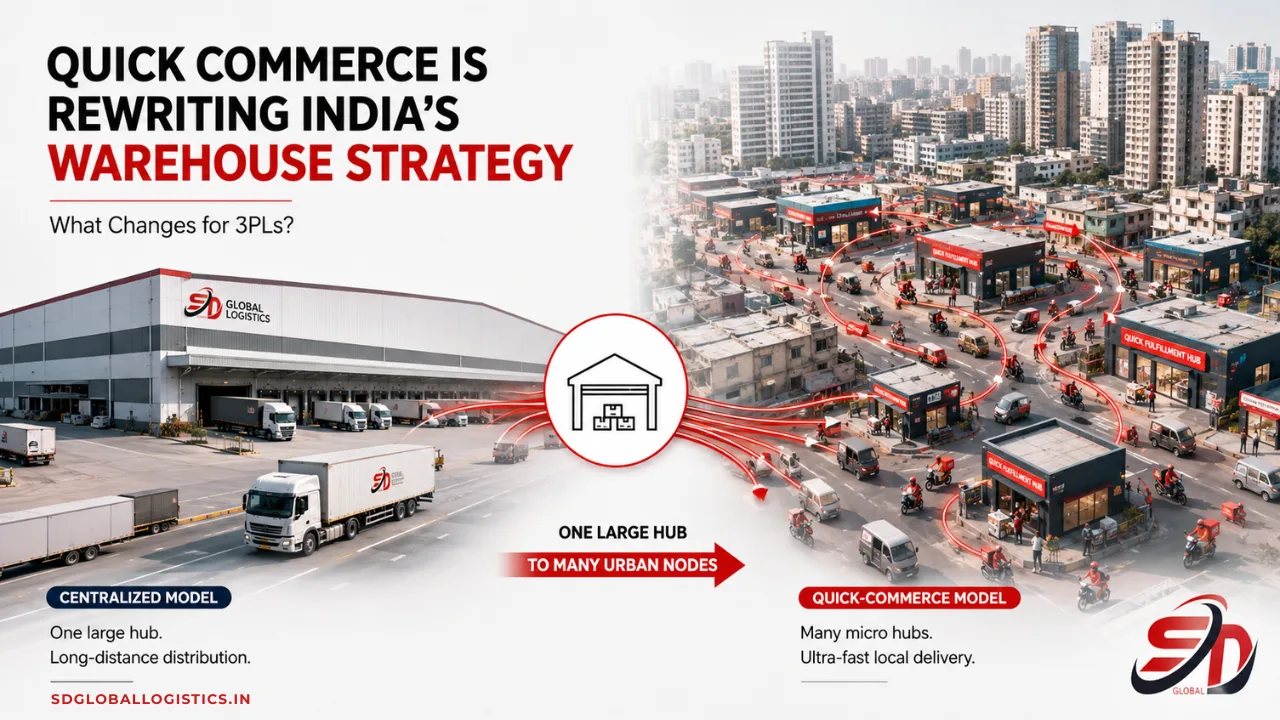
Quick commerce is pushing businesses away from centralised warehousing toward faster, more distributed fulfilment networks — and it is changing everything about how 3PLs manage inventory, locations....
View Blog75+ warehouse locations positioned across major industrial, commercial and distribution markets.
SD Global Logistics — your pan-India partner delivering scalable warehousing, technology-driven supply chain solutions and reliable, cost-efficient logistics for growing businesses
Developed By Rapiditors Technology India Pvt Ltd © 2025. All rights reserved.
Marcus
Ask me anything, I am here to help you.